Search This Blog

Showing posts with label Rhodococcus. Show all posts

Tuesday, 18 June 2013

New nitrile hydratase papers


Enzyme–Substrate Binding Landscapes in the Process of Nitrile Biodegradation Mediated by Nitrile Hydratase and Amidase from Yu Zhang, Zhuotong Zeng, Guangming Zeng, Xuanming Liu, Ming Chen, Lifeng Liu, Zhifeng Liu & Gengxin Xie in Applied Biochemistry and Biotechnology describes molecular modelling experiments using the crystal structures 2QDY (AJ270 Fe based NHase) and 1IRE (Pseudonocardia thermophila Co based NHase).This is a docking study for these two enzymes and a downstream amidase. Available at DOI 10.1007/s12010-013-0276-1. Shown below is Fig1b which illustrates a binding mode between the P. thermophila Co based NHase and 3-cyanopyridine.


Strategy for successful expression of the Pseudomonas putida nitrile hydratase activator P14K in Escherichia coli by Yi Liu, Wenjing Cui , Yueqin Fang, Yuechun Yu, Youtian Cui, Yuanyuan Xia, Michihiko Kobayashi and Zhemin Zhou adds to debate around the activator which is used for the maturation of the NHase with inclusion of the metal centre  (they say an activator is always needed, but is that true?). This paper is found in BMC Biotechnology at DOI:10.1186/1472-6750-13-48 and describes a methodology to ensure that the P14K activator is expressed successfully and in a more stable form.

Monday, 24 September 2012

Diversity in Rhodococcus Sequences on NCBI

Downloading all the alpha chain amino acid sequences of nitrile hydratases of Rhodococcus origin from NCBI, you get over 100 sequences. By eliminating all the ones which are from PDB entries, you get 98 sequences. By using the usual amino acid sequence tag to identify which metal centre present, you get 68 iron-centred NHases and 24 cobalt-centred NHases, and six bits of rubbish. Of the iron centred ones, 61 have the VCSLC tag starting at position 109. None of the remaining have the metal binding region starting in the same place, and range from 96 to 149. There is much more of a spread with the cobalt centred sequences if you track the equivalent tag, as the histogram below shows.

Monday, 3 September 2012

New publications- September 2012

There are two new publications:
  • A review on stereoselectivity in nitrile hydratases by Anming Wang and co-workers in the African Journal of Microbiology Research (DOI: 10.5897/AJMR12.101). I am not sure it adds much to previous reviews. 
  • A paper called “Biotransformation of benzonitrile herbicides via the nitrile hydratase–amidase pathway in rhodococci” in the Journal of Industrial Microbiology and Biotechnology with Ludmilla Martınkova as corresponding author (DOI: 10.1007/s10295-012-1184-z). It looks at the ability of Rhodococcus rhodochrous PA-34 and Rhodococcus erythropolis A4 to hydrate and hydrolyze chloroxynil, bromoxynil, iodoxynil and dichlorobenil. The NHase seemed to be able to turnover the herbicides more easily than the downstream amidases were able to hydrate the resulting amides.

Friday, 31 August 2012

Another 4D mutant of Rhodococcus rhodochrous PA-34 paper

There is a new paper on the 4D mutant of Rhodococcus rhodochrous PA34 from Pratush, Seth and Bhalla.
They give methodology for how to purify the NHase out of the mutant cells, and then test it against a set of standard compounds under a range of conditions.
As a cobalt-centred NHase, you might expect it to turnover aryl nitriles better than alkyl nitriles if the simplistic “rule of thumb” operated but this seems to be pretty undifferentiated. (see one panel from their Figure 4 below).

This mutant also seems to have a temperature maximum somewhere in the region of 45-60oC (they go for 55oC) which as the authors note is sort of high for a NHase (and higher than for wild type Rhodococcus rhodochrous PA34 which is quoted as 40oC). Another panel of their Figure 4 shows this below.

Friday, 3 August 2012

New papers for August

There are two new papers, both on Rhodococcus rhodochrous NHases, out there:
  • Cloning, Sequencing, and Expression of Nitrile Hydratase Gene of Mutant 4D Strain of Rhodococcus rhodochrous PA 34 in E. coli, by Amit Pratush, Amit Seth and T. C. Bhalla in Applied Biochemistry and Biotechnology, DOI: 10.1007/s12010-012-9790-9.
A clone carrying a new NHase which is cobalt centred and very similar to Rhodococcus rhodochrous J1 is reported.
  • Effect of growth media on cell envelope composition and nitrile hydratase stability in Rhodococcus rhodochrous strain DAP 96253, by Trudy-Ann Tucker, Sidney A. Crow Jr. and George E. Pierce in Journal of Industrial Microbiology & Biotechnology, DOI: 10.1007/s10295-012-1168-z
This looks at how being in a Rhodococcus species might impact on the activity of the NHase enzyme on board.  They show that altering sugars in the growth medium affects the cell envelope components and impacts on NHase activity. I had heard this sort of thing can affect the activity of NHases in other prokaryotes too. In fact, I know someone who improved their enzyme activity by accidentally leaving something going overnight…

Thursday, 5 July 2012

NHase reviews in recent books

I have recently come across two book chapters which would be of interest to those interested in nitrile hydratase (and indeed nitrilases) enzymes.
Biocatalysis for the Pharmaceutical Industry: Discovery, Development, and Manufacturing edited by Junhua (Alex) Tao, Guo-Qiang Lin and Andreas Liese has a chapter on “Applications of Nitrile Hydratases and Nitrilases” written by Grace DeSantis and Robert DiCosimo.
Biology of Rhodococcus edited by Héctor Alvarez, whilst sounding a touch unpromising has a chapter co-written by Ludmila Martınkova entitled “Catabolism of Nitriles in Rhodococcus” which runs through a lot of the synthetic potential that the NHases from this type of prokaryote possess in detail I haven’t seen altogether in one place before.

Monday, 7 March 2011

How many clearly different structures of NHase are reported as pdb files?

Another helpful thing that the Iterative Magic Fit function within DeepView can do is provide a numerical value (based on a RMS calculation) for the similarity of the three dimensionality of the enzymes being overlaid. After concentrating on enzymes which are clearly NHases, discarding structures which are clearly mutants of an existing structure (which is either obvious from the title or the combination of author and date of submission), you get left with 13 distinct pdb files [1AHJ, 1IRE, 1UGP, 1V29, 2AHJ, 2CYZ, 2CZ6, 2D0Q, 2DPP, 2QDY, 2ZPB, 3A8O and 3HHT]. I then IMFed every one of these against each other to get a matrix of values for similarity. Basically if they had a value of less than 0.5, they look pretty much the same, greater than 1 than they look noticeably different.
The results of this showed that ALL the iron centred enzymes have RMS of <0.5 with each other which is not entirely surprising since they are all from Rhodococcus species. They all have RMS of greater than 1 for all the cobalt centred enzymes. There are two distinctly different cobalt centred arrangements: the Pseudonocardia thermophila pair of 1IRE and IUGP, and the trio of Bacillus structures of 1V29, 2DPP and 3HHT. Within these groupings they have RMS of less than 0.5, and between the groupings RMS of greater than 1.
Effectively this says to me that there are three basic structures for NHase known currently- one iron based and two cobalt based. Below is an excerpt from a table holding all the results from these calculations which shows this clustering.
PDB ID

1.06
1.06

1.06
0.07
1.19
1.14
0.45
1.09
0.44
1.07
0.47
1.09
0.45
1.09
1.22
1.16
0.46
1.09
0.44
1.08
3A8O
0.47
1.11
3HHT
1.22
1.15

Wednesday, 2 March 2011

The extra helix in a cobalt-centred NHase

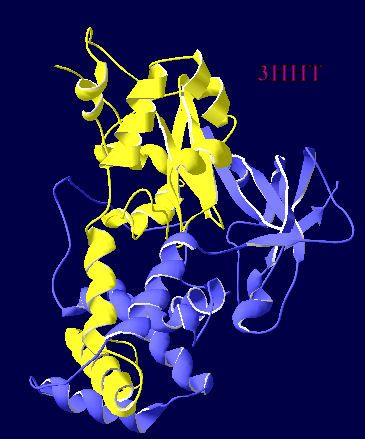
Using Deepview, I thought I would produce a matched pair of views of the two different metal centred NHases in ribbon view so that it was really obvious where the extra helix was. 3HHT is the crystal structure of a cobalt centred Geobacillus and 2QDY is the crystal structure of iron centred AJ270.
  

Thursday, 24 February 2011

3A8O vs 2QDY

I have been playing with Deepview which offers a handy function where you can overlay pdb files and the resulting structure is colour coded for alignment diversity. Blue indicates really not much at all. As I have mentioned before the pdb for the Rhodococcus species AJ270 is coded as 2QDY and that for Rhodococcus species N-771 is 3A8O. Overlaying these two shows almost everything is dark blue, apart from differences for the two post-translationally modified cysteines in the active site and one bit dangling off the end. So that would be very similar then. You can see the same sort of picture if you overlay these with the 2CYZ too.

Wednesday, 23 February 2011

Unravelling the mechanism of NHase hydration

This paper (corresponding author, Masafumi Odaka) develops the knowledge around how a nitrile hydratase actually manages to stuff a water into a rather stable carbon-nitrogen triple bond. It also resulted in a rather nice suite of crystal structures- one parent structure (in pdb as 3A8O) and four single point mutants.
*Kinetic and structural studies on roles of the serine ligand and a strictly conserved tyrosine residue in nitrile hydratase - Yamanaka, Hashimoto, Ohtaki, Noguchi, Yohda and Odaka, in Journal of Biological Inorganic Chemistry (2010), doi: 10.1007/s00775-010-0632-3

This is an image produced using DeepView of 3A8O with the position of the iron labelled.

Wednesday, 9 February 2011

3D structure of AJ270 NHase

We have worked with the nitrile hydratase from Rhodococcus erythropolis AJ270 which was a bacterium which was collected on the banks of the river Tyne in Newcastle. The key authors who have worked with this bacterium in synthesis over the years are Otto Meth Cohn (at Sunderland University) and Mei-Xiang Wang  (originally working with OMC but now at the Chinese Academy of Sciences, Beijing). M-X W has published a crystal structure of the nitrile hydratase from AJ270, and it can be found on PDB as 2QDY here. A little bit of playing with the data using PyMol and you can see how the two subunits fit together, and how there is a small channel from the exterior of the enzyme down into the active site.

Saturday, 5 February 2011

Two recent articles on NHases

*Unique Biogenesis of High-Molecular Mass Multimeric Metalloenzyme Nitrile Hydratase: Intermediates and a Proposed Mechanism for Self-Subunit Swapping Maturation-

Zhou, Hashimoto, Cui, Washizawa, Mino, and Kobayashi in Biochemistry (2010)
DOI: 10.1021/bi100651v

An investigation of the subunit structure of the NHases in Rhodococcus rhodochrous J1.

.
*High-yield continuous production of nicotinic acid via nitrile hydratase-amidase cascade reactions using cascade CSMRs 

Cantarella, Gallifuoco, Malandra, Martinkova, Spera, and Cantarella in Enzyme and Microbrial Technology(article in press, 2010)
DOI: 10.1016/j.enzmictec.2010.12.010

This looks at using the NHase/amidase system from Microbacterium imperiale CBS 498-74 in a bioreactor to convert 3-cyanopyridine to nicotinic acid.